Showing posts with label Irons Collection - Koleksi seterika. Show all posts

Sunday, June 13, 2010

Antique Vintage Charcoal Irons - Seterika Arang Antik


Antique Vintage Charcoal Irons

This charcoal iron shape is a bit unique. Made from Cast Iron material.
Aproximate length about 270mm
Price:RM380

Ironing brief info

Ironing is the work of using a heated tool, or tools, (an iron) to remove wrinkles from fabric. The heating is commonly done to a temperature of 100°Celsius. Ironing works by loosening the bonds between the long-chain polymer molecules in the fibers of the material. While the molecules are hot, the fibers are straightened by the weight of the iron, and they hold their new shape as they cool. Some fabrics, such as cotton, require the addition of water to loosen the intermolecular bonds. Many modern fabrics (developed in or after the mid-twentieth century) are advertised as needing little or no ironing. Permanent press clothing was developed to reduce the ironing necessary by combining wrinkle-resistant polyester with cotton.

Ironing may also be used as a germ/parasite killing hygienic operation, such as in areas where the Tumbu fly is prevalent.

While nobody knows precisely when the practice began, people have been smoothing clothes with a variety of items, including glass, wood, and stones, since before recorded history. The first known use of metal to "iron" clothes, however, is known to have occurred in China.

The electric iron was invented in 1882, by Howard Seeley. Seeley patented his "electric flatiron" on June 6, 1882 (U.S. Patent no. 259,054).

Saturday, May 15, 2010

Gasoline Iron - Seterika gas


This Gasoline Irons is made in England.
I do not know whether it's working or not. I just keep it as a display items.
Price for both irons: RM400 or RM250 per pc

History of Clothing Irons

Though objects have been used for thousands of years to remove wrinkles and/or press clothing, for much of that time only the wealthy had their clothes so treated. Because the use of such implements was hard and laborious, only the rich could afford to employ people (usually slaves or servants) to do the work. In about 400 B.C. , Greeks used a goffering iron to create pleats on linen robes. The goffering iron was a rolling pin-like round bar that was heated before use.

Empire-era Romans had several tools similar to the modern iron. One was a hand mangle. This flat metal paddle or mallet was used to hit clothes. The wrinkles were removed by the beating. Another implement was a prelum. This was made of wood and not unlike a wine press. Two flat heavy boards were put between a turnscrew, also made of wood. Linen was placed between the boards and the increasing pressure applied by the turmscrew created pressure to press the fabric.

The ancient Chinese also had several primitive types of irons, including the pan iron. The pan iron looked rather like a large ice cream scoop. This iron had an open compartment with a flat bottom and a handle. The compartment held hot coal or sand, which heated the bottom of the pan iron. It was moved across clothing to remove wrinkles.

By about the tenth century A.D., Vikings from Scandinavia had early irons made of glass. The Vikings used what was called a linen smoother to iron pleats. The mushroom-shaped smoother was held near steam to warm up, and was rubbed across fabric.

What contemporary consumers would recognize as an iron first appeared in Europe by the 1300s. The flatiron was comprised of a flat piece of iron with a metal handle attached. To heat the iron, it was held over or in a fire until it was hot. When a garment was pressed with the flatiron, it was picked up with a padded holder. A thin cloth was placed between the garment and the iron so that soot would not be transferred from implement to the finished garment. The flatiron was used until it was too cool to do its job. Many people owned several flatirons so they could heat one or more while one was being used.

In approximately the fifteenth century, an improvement over the flatiron was introduced. The hot box (also known as the box iron or slug iron) was made of a hollow


A typical clothes iron.
metal box with a smooth bottom and a handle. Inside, hot coals, bricks, slugs (heated metal inserts) or some other heating element were placed. This eliminated the need for an extra cloth between clothing and iron because the iron did not get the clothes dirty. Both the flatiron and hot box were used for several hundred years.

Many innovations in iron technology came in the nineteenth century. When cast iron was invented in the early part of the nineteenth century, some of the problems with flatirons were solved. With the advent of cast iron stoves, flatirons could be heated on top of them, which was much cleaner than a fire. By the 1820s, cast iron was also used to make flatirons. These irons were called sad irons because they were heavy, weighing about 15 lb (5.6 kg), and hard to move.

Like flatirons, sad irons were heated on the stovetop, but they sometimes heated unevenly. The handle also heated up, which posed problems for users. American Mary Potts solved these predicaments in 1870. She made a cardboard base and filled it with plaster of Paris. This was placed around the iron's body and kept it cooler for more even heating. Potts also devised a detachable wooden handle that was spring loaded for the sad iron. Because wood does not hold heat in the same way that iron does, the person using the iron would not be burned.

After gas became available in American homes in the late 1800s, gas irons came into existence. The earliest were patented in 1874. Homes had individual gas lines into them, and the gas iron was hooked up to the gas line by a pipe. The iron contained a burner to which the gas flowed. When the burner was lit with a match, the iron heated up. The iron was very hot and gas sometimes leaked, but the gas irons were lighter than sad irons. Other fueled irons soon followed. These irons were heated with oil, gasoline, paraffin, and other fuels.

The electric iron was invented in the 1880s when electricity became widely available in homes. The first electric iron was patented by Henry W. Seeley in 1882. His iron was hooked up to an electrical source by detachable wires. The electricity stimulated the iron's internal coils. But Seeley's iron, like many early electric irons, did not have electric cords. The irons were heated on a stand. One big problem with Seeley's iron was that it heated very slowly on the stand, and cooled quickly while in use. This iron had to be reheated frequently.

By the turn of the century, iron technology had progressed considerably and irons became more common in American house-holds. In 1903, irons with electric cords directly attached to the iron were being sold. Earl Richardson invented a sole plate (the bottom part of the iron that is made of metal and does the actual pressing) that improved how and where sole plates were heated for better ironing. His iron had more heat in the tip than in the center and was known as the Hotpoint.

In the 1920s, Joseph Myers improved the iron and cord by adding an automatic heat control made of pure silver. Thermostats soon became a standard feature. The first cordless irons were introduced in 1922, though they did not catch on. (The first successful cordless irons were sold in 1984).

In 1926, the steam iron was introduced by the Eldec Company. Steam made it easier to smooth dry stiff fabrics. Previously the user sprinkled water on dry clothing, or clothing had to be ironed when damp. The steam irons employ a water tank that allows heated water vapor to be created and applied through small holes on the sole plate. Steam irons did not become popular until the 1940s.

Edward Schreyer conquered the problem of rusting sole plates in 1938. He developed an aluminum alloy that would not rust or leak. Irons that could vary between steam or dry were introduced in the 1950s. The first iron with automatic shut off was introduced in 1984.

Contemporary irons have nonstick coating on the sole plate, an innovation that was introduced in 1995. Most featured bodies made of plastic and more holes on the sole plate to allow steam to come through. A whip holds the cord out of the way during use. In 1996, about 13-14 million irons with a variety of features were sold in the United States

Monday, May 10, 2010

Charcoal Irons 6 - Seterika arang lama


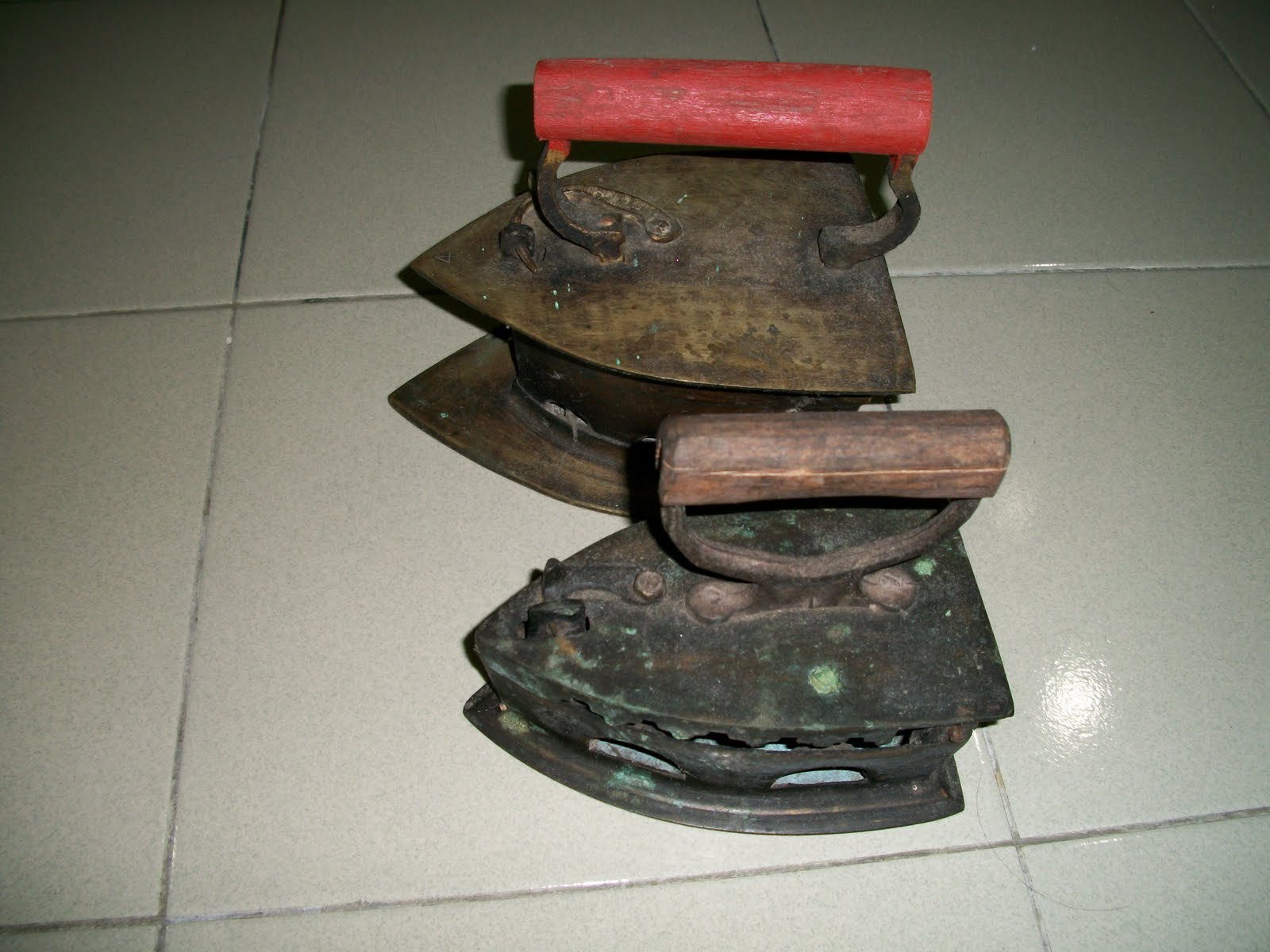
3 smalls and 1 large charcoal irons. All made from brass material.
Very nice for your display collection.

Price:RM800 for 4 pcs

Ironing History

Charcoal iron

Cluster of solid metal irons, heated from the single source.
Metal pans filled with charcoal were used for smoothing fabrics in China in the 1st century BC. From the 17th century, sadirons or sad irons (from an old word meaning solid) began to be used. They were thick slabs of cast iron, delta-shaped and with a handle, heated in a fire. These were also called flat irons. A later design consisted of an iron box which could be filled with hot coals, which had to be periodically aerated by attaching a bellows. In Kerala in India, burning coconut shells were used instead of charcoal, as they have a similar heating capacity. This method is still in use as a backup device since power outage is frequent. Other box irons had heated metal inserts instead of hot coals. Another solution was a cluster of solid irons that were heated from the single source: as the iron currently in use cools down, it can be quickly replaced by another one that is hot. In the late nineteenth and early twentieth centuries, there were many irons in use which were heated by a fuel such as kerosene, alcohol, whale oil, natural gas, carbide gas (acetylene) as with carbide lamps, or even gasoline. Some houses were equipped with a system of pipes for distributing natural gas or carbide gas to different rooms in order to operate appliances such as irons, in addition to lights. Despite the risk of fire, liquid-fuel irons were sold in U.S. rural areas up through World War II. On 16 February 1858 W. Vandenburg, and J. Harvey, patented an ironing board that made pressing sleeves and pant legs easier (U.S. Patent 19,390 ). In the industrialized world, these designs have been superseded by the electric iron, which uses resistive heating from an electric current. The hot plate, called the sole plate, is made of aluminium or stainless steel. The heating element is controlled by a thermostat which switches the current on and off to maintain the selected temperature. The invention of the resistively heated electric iron is credited to Henry W. Seely of New York in 1882. In the same year an iron heated by a carbon arc was introduced in France, but was too dangerous to be successful. The early electric irons had no easy way to control their temperature, and the first thermostatically controlled electric iron appeared in the 1920s. Later, steam was used to iron clothing. Credit to the invention of the steam iron goes to Thomas Sears. The world's largest collection of irons, encompassing 1300 historical examples of irons from Germany and the rest of the world, is housed in Gochsheim Castle, near Karlsruhe, Germany.

Charcoal Irons 5 - Seterika arang lama


This charcoal iron shape is a bit unique. Made from brass material.
Aproximate length about 270mm
Price:RM280

Antique Clothes Irons
A little piece of collectible history

Many people celebrate the antique clothes iron as a small piece of domestic history. These unique appliances even have their own collectors' clubs and museums, and indeed, the history and craftsmanship these antique irons possess do indeed make them quaint collectibles or even unique accent pieces in a home.

The first irons as we know them today were called sadirons, from the old English word "sald," meaning solid. The oldest version was called a flat iron, and was a simple piece of flat metal with a handle that was held in the fire for heating. There were also irons that were filled with charcoal kept hot with the use of bellows. In the 1820s, cast iron was invented, and the clothes iron changed. The new material was easier to heat and cleaner to use, but these antique irons weighed up to 15 pounds and were difficult to move.

An American woman by the name of Mary Potts developed and patented several features of latter antique irons. She proposed that an iron should have a hollow body filled with a non-conductive material like plaster-of-Paris to allow for longer and more even heating. She also invented a spring-loaded, detachable wooden handle to eliminate the danger of burns, endearing herself to housewives everywhere.

The rustic simplicity of the antique clothes iron makes it an art piece in and of itself. There are many different styles available from all over the world, from hand flutter irons to gas irons to rare asbestos irons. They can be used as doorstops, unique paperweights, or display pieces.

Whether you are a collector or you just appreciate the historical value of these pieces, there is no doubt that the antique iron connects us to the past in a very tangible way, highlighting both the differences and similarities of day-to-day life in the present and in bygone eras.

Charcoal Irons 4 - Seterika Arang Lama


4 pcs Charcoal irons (2pcs made by Cast Iron and 2pcs made by Brass material)
Approximate Length 270mm(large) and 240mm(small)

Price:RM500 for 4pcs

The History of Coal Iron Presses

RobbyBer of German Wikipedia The charcoal iron is a precursor to the modern electric steam iron. It was an iron roughly shaped like its modern counterpart, but with a hollow interior that could hold smoldering charcoal, which would keep the iron hot.
Definition
The charcoal iron is an ancestor to the modern electric iron. While today's irons use electricity to heat their metal bases and to generate steam, charcoal irons were heated by smoldering coals which were taken from a fire and placed inside a box on the top of the iron. The lid of the box had a handle which allowed people to hold the hot iron as they ran it over clothing, smoothing out wrinkles.
Earliest Days
The earliest examples of charcoal irons were found in China. There are paintings dating back to over a thousand years ago depicting women using an early charcoal ironing process. People would place charcoal in a metal pan and run it over silk and other wrinkled fabrics.
Early Ironing in the West
In the Western world, people ironed their clothing with "sad irons," which were extremely heavy iron bars with handles that were heated in a fire. People would take the iron out of the fire, holding it with a cloth. However, these sad irons were poor performers because they cooled quickly and required constant reheating.
Evolution of Modern Charcoal Irons
Some time in the 19th century, people in the west caught up to China in a sense. They developed the iron boxes described above. These charcoal irons stayed hot longer than sad irons and were easier to use. The charcoal iron had to have holes or vents along the sides to allow the coals to get enough air to continue burning.
Charcoal Irons Today
Today many charcoal irons are bought and sold in the antique industry. The irons are also still in use in some developing nations where electricity isn't is cheap and accessible.

Sunday, May 9, 2010

Charcoal Irons 3 (Rooster type)- Seterika Arang Ayam lama


Both Rooster irons made by Cast irons
Aproximate Length 270mm
Price:RM700 for both roosters


CHARCOAL IRONS

Charcoal Irons or coal irons as the name suggests holds embers from wood or coal fires and are extremely cumbersome and require quite some skill in not smudging the clean washing or even burning from ashes escaping by way of the many vent holes. In third world countries these irons are still in use and are still being manufactured.


Type of irons


Sad irons do not mean unhappy irons as the word now implies, but to mean being heavy. So all heavy irons are known as sad irons. Sad heating irons as we know them now, are recorded back to the beginning of the 16th century. When they came into general use in Europe, it was the Dutch that pioneered its popularity, though goffering irons were used in the early 12th century to facilitate the pressing of frills, ruffles and pleats in France.

Smoothing Stones have been around since the 8th and 9th century and are known as the earliest western ironing devices, looking somewhat like a large mushroom. In Scandinavia they are known as slicken stones, slekje meaning to polish and smooth. Made from various hard materials, wood, glass, stone and bone etc., one or two hands were used to press firmly down upon the fabric and pressed in a rubbing manner back and forth using friction for heat. In parts of Holland they are still used to this day, preparing the starched parts of their National costume by polishing and smoothing, but here known as leksteen.

Smoothing Board or mangle board are another early ironing device, wrapping the fabric around a poker type roller (50mm to 75 mm dia.) the flat handled board was pressed in a rolling motion until the desired result was achieved. Made of hard wood and ornately carved and painted these boards were often given away as presents or wedding gifts with personal markings.

Linen Presses as the name implies was also an early method for pressing fabric, not unlike a book press that has two hard flat surfaces and squeezed together via a threaded rod. The fabric being placed between the two plates and flattened with the pressure.

Goffering Irons as earlier mentioned, were slender rods or cigar like tubes on a stand or used individually like a poker. Heated either with a hot slug or over heat and varied in size, to the size of the ruff required, some being very decorative.

Fluter Irons come in many guises some quite novel, as combination flat iron and rocker, single purpose flat iron and board/plate or intricate mechanical devices with a rotating handle. Introduced in the mid to late 18th century they quickly replaced earlier means of pleating and crimping damp material. American and British manufactured fluters are distinguished by the rib spacings American being much broader, by a third. Heating fluters was done by the usual hot slug, charcoal, spirit or stove heated etc.

Box Irons manufactured mainly in Europe and fabricated in many materials. The very ornate brass irons capturing high value sales today, many irons being individually made in an art form. Heating being applied via a hot slug entered into the box, either at the rear or a hinged top, the huge variations of this iron makes it a popular collectors choice.

Electric Irons first patented in America in 1883 have over the years become the easiest iron to use, now ultra light with teflon soles, multiple steam jets and even cordless as surprisingly was the first. What a dream that would have been in days gone by or our poorer neighbors. Since the turn of the century electricity has revolutionized the method of heating irons, gone now are the days of danger of burning wood, coal or liquid fuels. There are many electric irons to collect.

Miniature Irons were not made only for children as toys but were the real thing for delicate work or other reasons. Many were promotional and given away as gifts and range through most of the irons earlier mentioned. Some collectors specialize solely in this area, the smallness allowing greater ease of presentation and handling.

Live Steam Irons used commercially in laundries all over the world are slowly being replaced with electric presses and other modern ironing devices. The live steam irons are heavy and very dangerous, being heated via flexible pipes/hoses through entry and exit fittings using very hot steam under pressure from a large boiler that would be used to run the whole laundry. Modern laundries have refined this practice now using light weight irons via a small individual boiler plugged into a wall socket.

In iron collecting there are also many other matters to consider such as cleaning and maintaining, how to display our pride and joy, where will our next masterpiece be found, how to photograph? Research is a facet of this hobby that particularly interests us, talking to lots of people and searching libraries for anything new. Book keeping is also important, cataloging each new find with what, where, when, size and how much etc. As collections grow this information becomes very important as our memories can only remember so much information.

Pressing instruments have been around for some time, the first is believed to have been used in China many thousands of years ago. This took the form of a ceramic or glass vessel filled with hot sand to smoth fine silks. Pressing irons have just evolved, necessity being the mother of invention. In older days pressing irons were tools for servants and not much was written about them, hence many grey areas unlike the cultural arts of the day or a historic War. Historians are searching for more information and it is slowly coming to light, as a collector I find this very interesting and learn more each day through contacts from a variety of sources.

Charcoal Irons 2 - Seterika Arang Lama


I got these 2 irons from one of my friends. The based of both irons is expanding from the body of the irons
Lenght: Approximate 270mm (large) and 240mm(small)
Price RM400 for both


IRONS - IRONS - IRONS!

So you say you collect….what? Pressing Irons!
How can that be? – How many are there?
Hundreds? Thousands? Even more! Educate me please.

The Evolution of the Pressing Iron

By: Lani Czyzewski

As seen in The Antique Shoppe Newspaper, October 2006


Crownall-English about the late 1800's


Sad Iron from the Ober Brothers Manufacturing Company - about 1900

Chinese Pan Iron from 1800-1850

Crank Fluter - patented in 1880

Smoothing Board - early 1800's

Alcohol iron - German patent 1897
The people of China began using long-handled brass pans filled with charcoal over one thousand years ago to press their silk. Since that time, a wide variety of irons have been developed in the attempt to find a solution to the problem of how to heat an iron efficiently -- and protect both the user and the cloth against burns. Smoothing Stones have been around since the 8th and 9th century and are known as the earliest western ironing devices, looking somewhat like large mushrooms.

“Necessity is the mother of invention” rings true when it comes to ironing. The ruff collar became popular in mid-1500 in Spain and France. Development was begun using starched cloth and a heated Goffering Iron. The decorated ruff was labor intensive and expensive so a practical use for making pleats was being sought.

In the 1600’s, 1700’s and 1800’s Linen Presses were widely used. The smoothing board was popular in Scandinavian Countries as early as the 1600’s. Women who took in washing hung the board outside their home with their names and the types of washing they did.

The box iron was made first by the Danes in the late 1600’s and had many advantages. This pressing iron had a cavity with a lug that held heat longer than most irons. The lug, with its ability to be removed, kept the pressing surface clean.

The Sad Iron was developed beginning in the 1800’s. The most common early irons were cast in one piece and weighed from five to seven pounds... many irons used by tailors and commercial cleaners often weighed as much as 20 pounds! Found abundantly in every country home, they were heated on cast iron stoves. They are commonly called "flat" or "sad" irons. "Sad" is an archaic word meaning "dense" or "heavy."

The composition varied over the years, from wood (without heat), iron, porcelain, to Bakelite or agate coating and soapstone. Much of the development centered around reducing the heat on the handle, which led to a revolutionary invention by Mary Potts -- removable handles. Mary Potts received a series of patents for variations on her iron where the body of the iron was cast hollow and later filled with material that was a non-conductor of heat, such as plaster of Paris, cement, or clay. Mrs. Potts claimed in her patent that this material held the heat longer so that more garments could be ironed without reheating the iron. The removable handle made it possible to have other irons heating while one was being used.

There were many different innovations to this necessary household item. One iron used a shelf where burning charcoal, or a bar of red-hot iron called a "slug," was placed. Another had an interior compartment where coals burned to ashes before fresh coals were added. These irons had chimneys that would reach a height of three inches or more, so the fumes and smoke wouldn't dirty the clean clothes.

The basic sad iron has some examples of fascinating attempts to keep the hand cool. Handles were slotted and coiled or ventilation and air flow. These are rare to find today. Combination irons, capable of doing more than one type of ironing job, reflect the nineteenth century's fascination with inventions and gadgets. They are found as sad/fluters and charcoal/fluters.

For ironing ruffles, the fluter had, for the most part, replaced the Goffering Iron by the 1860’s. Both crank and hand fluters were heated by rods or rectangular lugs. To save money in the home, functions were combined to pleat and polish in one unit. There are nearly as many different types of fluters as there are pressing irons.

Many foundries produced these irons. One of the largest was the Ober Brothers foundry in Chagrin Falls, Ohio. Founded in 1873, they became a household name -- their catalogs were printed in four languages and they shipped merchandise all over the world.

Throughout the centuries many different sources of heat for ironing were used, including charcoal, alcohol, kerosene, gas – and finally electricity. However, even with the advent of electricity, not all houses were wired and some rural areas still used charcoal, gas, or sad irons.

Although lacking elegance and refinement, old-fashioned irons have warmth of character making them popular collectibles.

By David Freeze, Lutz, FL
David and his wife Chris have a consignment area at Lani’s Antiques & Collectibles in Temple Terrace, Florida. All the irons shown in the photographs are part of Dave’s personal collection.

Saturday, May 8, 2010

Charcoal Irons 1 - Seterika arang


OLD CHARCOAL IRON - Seterika Arang Lama

Both are made from brass material
Length: Aproximately 150mm (small irons) and 270mm (large iron)
Price:RM400 for both Irons


Brief History of ironing

No-one can say exactly when people started trying to press cloth smooth, but we know that the Chinese were using hot metal for ironing before anyone else. Pans filled with hot coals were pressed over stretched cloth. A thousand years ago this method was already well-established.

Meanwhile people in Northern Europe were using stones, glass and wood for smoothing. These continued in use for "ironing" in some places into the mid-19th century, long after Western blacksmiths started to forge smoothing irons in the late Middle Ages.

If you make the base of your iron into a container you can put glowing coals inside it and keep it hot a bit longer. This is a charcoal iron, and the photograph (right) shows one being used in India, where it's not unusual to have your ironing done by a "press wallah" at a stall with a brazier nearby. Notice the hinged lid and the air holes to allow the charcoal to keep smouldering. These are sometimes called ironing boxes, or charcoal box irons, and may come with their own stand.

For centuries charcoal irons have been used in many different countries. When they have a funnel to keep smokey smells away from the cloth, they may be called chimney irons. Antique charcoal irons are attractive to many collectors, while modern charcoal irons are manufactured in Asia and also used in much of Africa. Some of these are sold to Westerners as reproductions or replica "antiques".

Some irons were shallower boxes and had fitted "slugs" or "heaters" - slabs of metal - which were heated in the fire and inserted into the base instead of charcoal. It was easier to keep the ironing surface spotlessly clean, away from the fuel, than with flatirons or charcoal irons. Brick inserts could be used for a longer-lasting, less intense heat. These are generally called box irons, although they used to be known as ironing boxes too.

Late 19th century iron designs experimented with heat-retaining fillings. Designs of this period became more and more ingenious and complicated, with reversible bases, gas jets and other innovations. See some inventive US models here. By 1900 there were electric irons in use on both sides of the Atlantic.