Showing posts with label Others Brass items. Show all posts

Tuesday, June 15, 2010

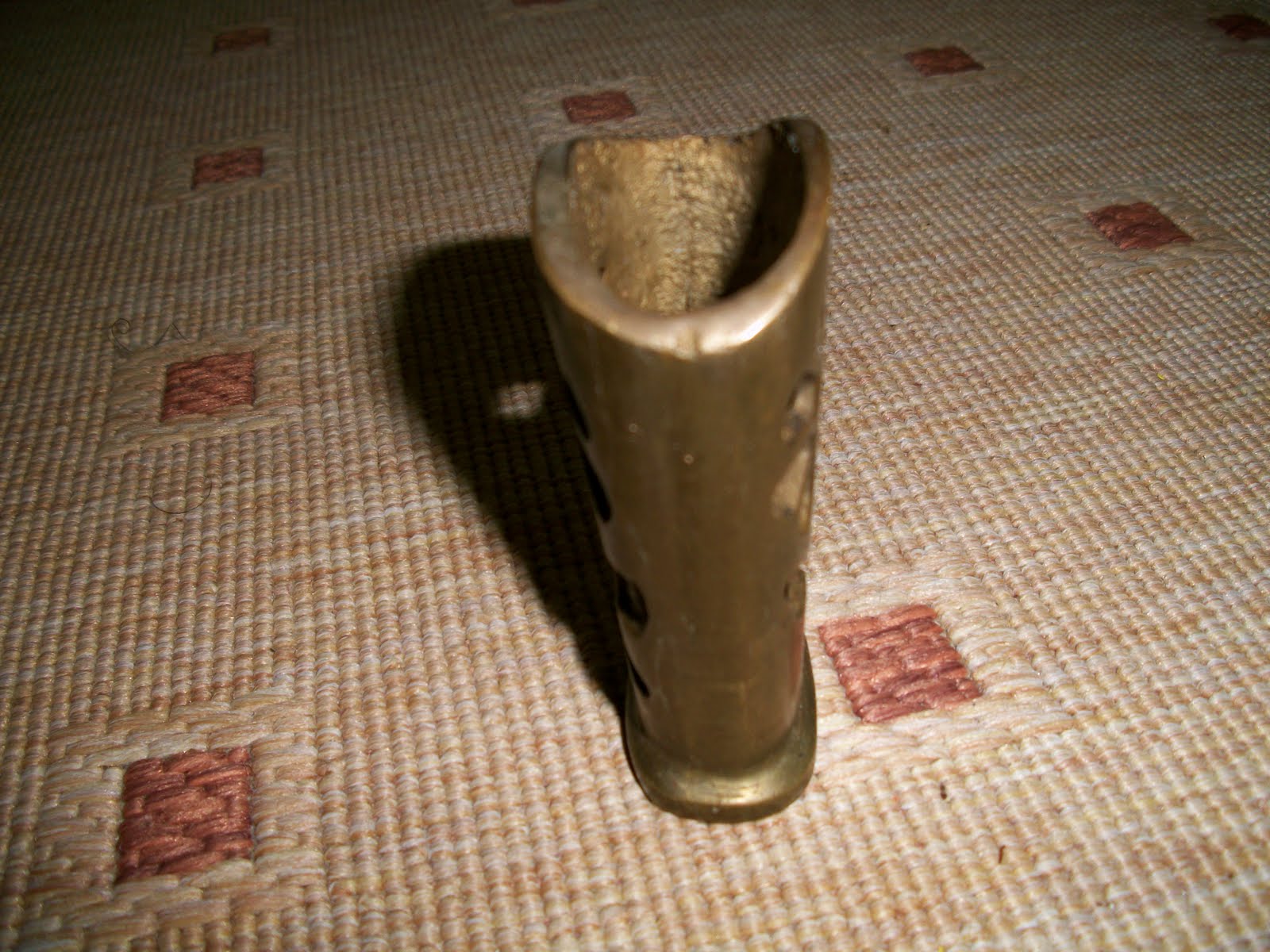
Vintage brass Coconut milk filter - Penapis santan tembaga lama


Vintage brass coconut milk filter

This is an old type coconut milk manual filter made from red brass.

Price:RM80


Filter for Coconut Milk

A coffee filter is a very good filter to run fresh coconut milk through. Comes out clean, with no little pieces or dust of the shell . Just place the filter on top of a cup or bowl and pour the coconut liquid through slowly.

Wednesday, June 9, 2010

Vintage "Mangkuk Tingkat" / "Sia" / "Muti level food container"


Vintage brass food container

This vintage "mangkuk tingkat" is made from red brass. This brass "mangkuk tingkat" consist of 5 level of food container.

Price:RM380

Tuesday, June 8, 2010

Antique / Vintage Bell


For whom the bell toll

This vintage / antique brass bell is the heritage of my friends family for years.
The handle is made from quality wood.(I do not know from what type of wood)

Price: RM280

BELLS AND HANDBELLS HISTORY

There is no record of when the bell was invented. There are pictures from early Chinese dynasties which clearly show bells, not the open method version beloved of bell ringers but the "Noddy" variety. Indeed they have been used by different civilisations in religious rites even before the development of a written language. They are mentioned in Exodus as part of Hebrew worship and they are shown decorating the robes of priests.

The early founders of the Celtic church in Britain, Saints Aiden, Cedd and Patrick, brought with them four sided bells similar to Austrian cow bells. St. Patrick's bell is still in his shrine in Dublin. In fact, handbells were the first bells to have appeared in England, the Romans using them to summon their servants. The large portable handbells which succeeded them were made of riveted iron plates immersed in molten bronze.

When the Christian church was recognised by Constantine in Rome, and came out of hiding, founders began to increase the size of bells and priests hung them on the outside of their churches. Paulinus at Nola in Campania is supposedly the first to have done this, and from his act derives the words campanile and campanology.

One of the rules of the church from this time read "Let all priests at the appointed hours day and night toll the bells in their churches then celebrate divine worship". This regular tolling became very important to people in early days. It was the only way they had of telling the time. The word clock derives from the Dutch word for bell "klok". The French "cloche" is also similar. In France in the thirteenth century bells were rung at 6.00 a.m. (Matins), Midday (Midi) and 6.00 p.m. (Vespers). These bells were later called the "Ave Maria" bells or the "Angelus". In Britain 'Midi' was called "None" or noon as it is today. Strange that this should be from the Latin 'none' for nine being nine hours after the first office 'Prime' at 3.00 a.m. So noon is really 9 o'clock not 12 o'clock!

In medieval times bells were steeped in superstition. This was probably because of their long association with religion. They were baptised, and once baptised had the power to ward off evil spells and spirits. Bells were hung in doorways to protect visitors and the visited from the evil spirits which always wait around the door awaiting the chance to slip inside. A visitor would ring the bell to drive the spirits away then pass inside - which is the likely origin of the present day doorbell! This custom also lead to the "Passing bell" which was rung to drive away spirits who stood at the foot of a bed and about the house ready to seize a person's soul as he died. The local ringers who were paid to ring the passing bell were paid more for a big bell than a small one, not because the big one was harder to ring but because it kept the spirits further away and gave the departing soul a better start. The sound of consecrated bells was also believed to dispel thunder and lightning and to calm storms at sea for all of which demons were believed to be responsible. When a tempest broke out bells would be rung in an effort to clear the storm. This happened for example at Sandwich in Kent, in the "great thundering" of 1502 and again in 1514 ' The "great thundering" was still in use against hail in Southern France in the nineteenth century as it was in Cornwall for those in peril on the sea.

After Bells had moved outside the church in Paulinus' time, handbells continued their development within the church. A cappella chanting (voices only) was replaced in popularity by more elaborate modes of liturgical accompaniment which included bells, stringed and wind instruments and small organs. Many mistranslations of the Latin "cymbala" used both for cymbals and bells in early times exist in psalms today, e.g. "Praise him upon the loud cymbals (big bells), praise him upon the well tuned cymbals (tuned handbells)." Early illuminations show small chimes of handbells hung from rods and in the early middle ages instructions for sung masses included the use of bells to double up on the tenor line. Perhaps church choirs have always been short of tenors (singers not bells). (In those days the tenor carried the tune.)

It was during the later middle ages that the organ finally ousted the wind instruments, strings, harps and bells, and it is likely that the bells were relegated to cupboards and boxes, perhaps in the towers, to be rung again during the 16th and 17th centuries by tower bell ringers who found it more agreeable to sit in the comfort of a local inn and practice their changes than to spend hours in a cold church tower..

Tune ringing became popular in the 1700's when the more musical tower bell ringers discovered that there were far less limitations to ringing handbells than ringing swinging tower bells - and there were likely to be more of them. They found that they could ring tunes, firstly carols and hymns, then chamber music and on to the popular classics. By the middle of the I9th century tune ringing had reached its heyday. At Belle Vue Gardens, Manchester, handbell ringing competitions were held from 1855 - 1925, to which special excursion trains ran, and bands from throughout the North of England played on up to 200 bells. Owing to the First World War and the invention of radio, apart from a very few large teams who kept going in the North of England, team membership dwindled and interest generally waned.

Twenty five years ago in England, most handbell owners were tower bell ringers or Societies, and they rang tunes on their bells only during the Christmas season, but gradually the art of tune ringing has revived. Music teachers and other leaders have realised the potential of bells and many schools and organisations now include tune ringing in their curricula. A Rally of local teams was organised at Norbury, Cheshire in 1966. This was so successful that those who took part decided to form a Society and the Handbell Ringers of Great Britain was thus born at Ashton-Under-Lyne in 1967.

In the United States of America the handbell tune ringing revival got off to an earlier start. Handbells were probably first heard there during the mid- nineteenth century. The American impresario, PT Barnum, imported the 'Lancashire Ringers' from England but called them 'Swiss Bell Ringers'! and a number of other itinerant teams performed to the public throughout the Eastern States. However, modern handbell tune ringing in the U.S.A. and their Society, the American Guild of English Handbell Ringers, owe their present standing to Mrs. A.A. Shurcliff who in 1926, after returning from a trip to England, complete with a small set of handbells given to her by English tower bell ringers, rang carols on Beacon Hill, Boston. The sound was heard and liked by others who sent to England for further handbell sets. Interest snowballed under the guiding hand of Mrs. Shurcliff. The New England Guild was formed in her living room in 1937 and 1954 saw the birth of the American Guild of English Handbell Ringers, also at her home. Tune ringing in America has never looked back.

Monday, June 7, 2010

Antique / Vintage Betel Leaf "Daun sireh" Container


For Betel leaf (Daun sireh) container only


This vintage / antique "Daun Sireh" (Betel Leaf) container is made from old brass material. It is used by malay oldies to store the betel leaf accesories or use for most of the ceremony in the malay culture.Very nice for home or office display items

Price:RM180

Manual "maruku" / biscuit maker


Anybody knows about this items? I think this is the manual biscuits/food/cake/"maruku" maker. This machines works when we spin the the top lever. Please correct me if I'm wrong.

Price:RM80

Old Brass Tepak Sireh / betel leaf container 3


Old Brass Tepak Sireh / betel leaf container 3


This vintage / antique "tepak sireh" is made from brass material. It is used by malay oldies to store the betel leaf accesories or use for most of the ceremony in the malay culture.It is beautifully handcarved and very nice for home or office display items

Price:RM280

Old Brass Tepak Sireh / betel leaf container 2


 6th Aug 2012 sold to Kay, from Singapore

Old Brass Tepak Sireh / betel leaf container 2


This old "tepak sireh" is made from brass material. It is used by malay oldies to store the betel leaf accesories or use for most of the ceremony in the malay culture.It is very nice for home or office display items

Price:RM120

Sunday, June 6, 2010

Old Brass Tepak Sireh / betel leaf container 1


This set of 2 "tepak sireh" is made from brass material. It is used by malay oldies to store the betel leaf accesories or use for most of the ceremony in the malay culture.

Price for 2 sets:RM180


Tepak Sireh information

Tepak sirih (betel leaf container) was used in almost every ceremony in Malays society as well as in social gatherings. Today, it is also used as a decorative item and one of the various exotic Malay handicrafts.

In general, tepak sirih contains seven uniquely selected items: betel nut, lime (kapur), extract from the leaves of gambier plant (gambir), tobacco, betel leaves and nutcracker (kacip). All of the items except "kacip" are kept in six different smaller containers known as "cembul".


Betel info

The Betel (Piper betle) is the leaf of a vine belonging to the Piperaceae family, which includes pepper and Kava. It is valued both as a mild stimulant and for its medicinal properties.

The betel plant is an evergreen and perennial creeper, with glossy heart-shaped leaves and white catkin. The Betel plant originated from South and South East Asia (India, Bangladesh and Sri Lanka).

Vernacular names
The betel leaf is known as Paan in Assamese/Urdu/Hindi/Odia/Bengali, and Taambuul and Nagavalli in Sanskrit. Some of the names in the regions in which it is consumed are: Vetrilai Tamil,Tamalapaku Telugu, Vidyache pan Marathi, veeleyada yele Kannada, Vettila Malayalam, Plū Mon, Malus Tetum, Maluu Khmer, Plue Thai, Malus Tetum, Bulath Sinhalese, Malu Tokodede, Bileiy Divehi, bulung samat Kapampangan language, daun sirih Malay language, Papulu Chamorro, Ikmo Philippines and Trầu Vietnamese.

Cultivation

A betel vineThe betel leaf is cultivated in most of South and Southeast Asia. Since it is a creeper, it needs a compatible tree or a long pole for support.

Paan cultivation is a special type of agriculture. High land and especially fertile soil are best for betel. Waterlogged, saline and alkali soils are unsuitable for its cultivation. In Bangladesh, farmers called barui prepare a garden called a barouj in which to grow betel. The barouj is fenced with bamboo sticks and coconut leaves, and on top it is also covered by paddy leaves. The land is dug well and laid out into furrows of 10–15 m length, 75 cm width and 75 cm depth. Oil cakes, cow dung, rotten farmyard manure and leaves are thoroughly incorporated with the topsoil of the furrows and wood ash. The creeper cuttings are planted after proper dressing in the months of May and June, at the beginning of the monsoon season. The plants are neatly arranged in parallel rows about two feet apart, and the saplings are twined around upright sticks of split bamboo and reeds.

Proper shade and irrigation are essential for the successful cultivation of this crop. The plants are regularly watered in the hot months. The leaves of the plant become ready for plucking after one year of planting and the production of the barouj lasts for several years from the date of planting. Betel needs constantly moist soil, but there should not be excessive moisture. Hence, frequent light irrigations are given. The quantity of irrigation water should be such that the standing water should not remain for more than half an hour in the bed. If water logging by heavy rains or excess irrigation occurs, drainage should be arranged immediately. The best time for irrigation is morning or evening.

Dried leaves and wood ash are applied to the furrows at fortnightly intervals and cow dung slurry is sprinkled. Application of different kinds of leaves at monthly intervals is found advantageous for the growth of the betel.


Betel leaf and Areca nut consumption in the world.In about 3–6 months time, vines grow to a height 150–180 cm. At this stage branching is noticed in the vines. Leaves are removed along with the petiole with the right thumb. Once harvesting is commenced, it is continued almost every day or week. The interval of harvesting varies from 15 days to about a month till the next lowering of vines. After each harvest, manuring has to be done.

There are various types of leaves, the most popular being : Calcutta, Banarasi, Magahi, etc. In Bangladesh Dinajpur, Rangpur, Chittagong, Faridpur, Jessore, Narayanganj, Barisal and Sylhet are the areas producing the most betel. The harvested leaves are used both for domestic consumption and for export to Middle East, to European countries, USA, UK, Pakistan, and Myanmar. Paan is one of the major economic sources of rural Bangladesh. The best Betel leaf is the "Magadhi" variety (literally from the Magadha region) grown near Patna in Bihar, India. In Kerala, the famous variety of betel leaf is from Venmony near Chengannur and it is called "Venmony Vettila". Betel leaf cultivated in Tirur in Kerala, Hinjilicut in Odisha are of fine quality. Betel leaves exported from Tirur are famous in Pakistan as "Tirur Pan".

Compounds
The active ingredients of betel oil, which is obtained from the leaves, are primarily a class of allylbenzene compounds. Though particular emphasis has been placed on chavibetol (betel-phenol; 3-hydroxy-4-methoxyallylbenzene), it also contains chavicol (p-allyl-phenol; 4-allyl-phenol), estragole (p-allyl-anisole; 4-methoxy-allylbenzene), eugenol (allylguaiacol; 4-hydroxy-3-methoxy-allylbenzene; 2-methoxy-4-allyl-phenol), methyl eugenol (eugenol methyl ether; 3,4-dimethoxy-allylbenzene), and hydroxycatechol (2,4-dihydroxy-allylbenzene)[citation needed].

Several terpenes and terpenoids are present in the betel oil as well. There are two monoterpenes, p-cymene and terpinene, and two monoterpenoids, eucalyptol and carvacrol. Additionally, there are two sesquiterpenes, cadinene and caryophyllene.

Chewing

Display of the items usually included in a chewing session. The leaves are folded in different ways according to the country and generally feature some calcium hydroxide daubed inside. Slices of the dry areca nut are on the upper left hand and slices of the tender areca nut on the upper right. The pouch on the lower right contains tobacco, a relatively recent introduction.
A phoenix wing shaped- betel leaf plate in Vietnam.There is archaeological evidence that the betel leaves have been chewed along with the areca nut since very ancient times. It is not known when these two different stimulant substances were first put together. In most countries, the mixture of both has a ceremonial and highly symbolical value.

In India, Burma, Nepal, Sri Lanka and other parts of South Asia, as well as South East Asia, the leaves are chewed together in a wrapped package along with the areca nut (which, by association, is often inaccurately called the "betel nut") and mineral slaked lime (calcium hydroxide). Catechu, called "Kattha" in Hindi, and other flavoring substances and spices might be added. The lime acts to keep the active ingredient in its freebase or alkaline form, thus enabling it to enter the bloodstream via sublingual absorption. The areca nut contains the alkaloid arecoline, which promotes salivation (the saliva is stained red), and is itself a stimulant. This combination, known as a "betel quid", has been used for several thousand years. Tobacco is sometimes added.

Betel leaves are used as a stimulant, an antiseptic and a breath-freshener Paan. In India, the betel and areca play an important role in Indian culture, especially among Hindus. Many traditional ceremonies governing the lives of Hindus use betel and areca. For example to pay money to the priest, they keep money in the betel leaves and place it beside the priest.

The betel and areca also play an important role in Vietnamese culture. In Vietnamese there is a saying that "the betel begins the conversation", referring to the practice of people chewing betel in formal occasions or "to break the ice" in awkward situations. The betel leaves and areca nuts are used ceremonially in traditional Vietnamese weddings. Based on a folk tale about the origins of these plants, the groom traditionally offer the bride's parents betel leaves and areca nuts (among other things) in exchange for the bride. The betel and areca nut are praised as an ideal combination to the point that have become important symbols of the ideal married couple bound together in love. Therefore in Vietnamese the phrase "matters of betel and areca" (chuyện trầu cau) is synonymous with marriage.

The high rate of oral cancer in South Asia is thought to be due to the chewing of betel preparations; the inclusion of tobacco may worsen the risk, but there is also evidence that the areca nut, alone or as part of a betel quid, may cause cancer even without tobacco.See its article for more discussion of this point. The addition of tobacco leaf to the chewing mixture is a relatively recent one, introduced during colonial times a few centuries ago.

Medicinal properties
In India, betel is used to cast out (cure) worms. And according to traditional Ayurvedic medicine, chewing areca nut and betel leaf is a good remedy against bad breath (halitosis).They are also said to have aphrodisiac properties.

In Malaysia they are used to treat headaches, arthritis and joint pain. In the Philippines, Thailand, Indonesia and China they are used to relieve toothache. In the Philippines, they are used specifically as a stimulant and was believed to strengthen the teeth and gums. In Indonesia they are drunk as an infusion and used as an antibiotic. They are also used in an infusion to cure indigestion, as a topical cure for constipation, as a decongestant and as an aid to lactation. Almost all Indonesian women use sirih leaves in bath water after giving birth as it shrinks the vaginal canal. It also counters unpleasant smells.[citation needed] The Indonesian government has endorsed betel leaves (daun sirih) as a natural medication against vaginal discharge.

A related plant P. sarmentosum, which is used in cooking, is sometimes called "wild betel leaf".

Saturday, June 5, 2010

Old brass tea set


This brass tea set is suitable for home decorative or display items.
Price: RM120

Thursday, June 3, 2010

Tepak Sireh -New old stock (NOS)


Thi "tepak sireh" is made from brass material. It is new old stock items, never used since new.

Price:RM280


Tepak Sireh information

Tepak sirih (betel leaf container) was used in almost every ceremony in Malays society as well as in social gatherings. Today, it is also used as a decorative item and one of the various exotic Malay handicrafts.

In general, tepak sirih contains seven uniquely selected items: betel nut, lime (kapur), extract from the leaves of gambier plant (gambir), tobacco, betel leaves and nutcracker (kacip). All of the items except "kacip" are kept in six different smaller containers known as "cembul".

Antique brass Doorknobs


4th Jan 2012-SOLD to Mr Wan From Terengganu, Malaysia

This antique doorknobs is made from brass material.The rings on the doorknobs is used to knock the door to inform the house owner that somebody is coming.


Price for 2 pieces:RM180


Doorknob History

American doorknob designs and materials have changed throughout the years. In colonial times the first door hardware was made out of wood, and involved simple latches and strings. Round knobs first appeared around the time of independence. Decorative hardware, including knobs, emerged after the Centennial Exposition of 1876. Before this time, most door hardware was imported; 95% in 1838.

Glass knobs were rare until a faster and cheaper manufacturing method was developed based on pressing. Pressed glass knobs were popular from 1826-1850, followed by cut glass through 1910. Wooden knobs were introduced in the late 1800s and were phased out after 1910. China or ceramic knobs were mainly imported from France and England until the mid-1800s, when the first U.S. patent was granted for making knobs out of potters clay.

Before 1846, metal knobs were made from two pieces brazed together or three pieces soldered together. Cast metal knobs were introduced around 1846. In the late 1800s, composite metal knobs were introduced as a less expensive knob. The main body was made out of iron or steel, covered entirely or in part with a veneer of bronze or brass. During the last half of the nineteenth century, many patents were issued regarding the spindle methods of attaching metal knobs for lock use, as well as designs for ornamenting these knobs. In 1870, a compression casting method was introduced that accelerated ornamentation of hardware.

Many of the Victorian doorknobs were made of cast bronze with ornamental patterns. During this period, a dozen major companies and many smaller firms produced hundreds of patterns of ornamented hardware, in addition to cast and wrought metal, glass, wood and pottery knobs. From 1830-1873, there were over 100 U.S. patents granted for knobs. Collectors have catalogued over 1,000 antique doorknob designs into 15 types based on shape, material, and design pattern. The best grade of knobs during this period were usually made from cast bronze or brass.

Around 1900, cast metal and glass knobs were introduced that incorporated ball bearings in the shanks of doorknobs. In operation, the knob shank rotated on sets of ball bearings fitted in the hardened steel cones. This reduced friction, assured closer adjustment, and eliminated endplay of the knobs. Other materials popular during the early 1900s included bronze and porcelain.

Most doorknobs come with some type of locking device. Machine processes for steel locks were first introduced in 1896. Today, the most common type of privacy lock is the spring lock, which uses a simple round, push button located in the center of the knob to control the bolt. It is easy to operate with a finger, closed fist, or elbow. Some locks come with both a spring lock and a dead bolt, which is operated by a key. Other locks have become more sophisticated, and use some sort of electronic device, such as a programmable computer chip that identifies users.

Wednesday, June 2, 2010

Miniature Brass Bell


I do not know any history of this bell. But it is very nice for table or cabinet display.

Price:RM120


BELLS INFORMATIONS

There is no record of when the bell was invented. There are pictures from early Chinese dynasties which clearly show bells, not the open method version beloved of bell ringers but the "Noddy" variety. Indeed they have been used by different civilisations in religious rites even before the development of a written language. They are mentioned in Exodus as part of Hebrew worship and they are shown decorating the robes of priests.

The early founders of the Celtic church in Britain, Saints Aiden, Cedd and Patrick, brought with them four sided bells similar to Austrian cow bells. St. Patrick's bell is still in his shrine in Dublin. In fact, handbells were the first bells to have appeared in England, the Romans using them to summon their servants. The large portable handbells which succeeded them were made of riveted iron plates immersed in molten bronze.

When the Christian church was recognised by Constantine in Rome, and came out of hiding, founders began to increase the size of bells and priests hung them on the outside of their churches. Paulinus at Nola in Campania is supposedly the first to have done this, and from his act derives the words campanile and campanology.

One of the rules of the church from this time read "Let all priests at the appointed hours day and night toll the bells in their churches then celebrate divine worship". This regular tolling became very important to people in early days. It was the only way they had of telling the time. The word clock derives from the Dutch word for bell "klok". The French "cloche" is also similar. In France in the thirteenth century bells were rung at 6.00 a.m. (Matins), Midday (Midi) and 6.00 p.m. (Vespers). These bells were later called the "Ave Maria" bells or the "Angelus". In Britain 'Midi' was called "None" or noon as it is today. Strange that this should be from the Latin 'none' for nine being nine hours after the first office 'Prime' at 3.00 a.m. So noon is really 9 o'clock not 12 o'clock!

In medieval times bells were steeped in superstition. This was probably because of their long association with religion. They were baptised, and once baptised had the power to ward off evil spells and spirits. Bells were hung in doorways to protect visitors and the visited from the evil spirits which always wait around the door awaiting the chance to slip inside. A visitor would ring the bell to drive the spirits away then pass inside - which is the likely origin of the present day doorbell! This custom also lead to the "Passing bell" which was rung to drive away spirits who stood at the foot of a bed and about the house ready to seize a person's soul as he died. The local ringers who were paid to ring the passing bell were paid more for a big bell than a small one, not because the big one was harder to ring but because it kept the spirits further away and gave the departing soul a better start. The sound of consecrated bells was also believed to dispel thunder and lightning and to calm storms at sea for all of which demons were believed to be responsible. When a tempest broke out bells would be rung in an effort to clear the storm. This happened for example at Sandwich in Kent, in the "great thundering" of 1502 and again in 1514 ' The "great thundering" was still in use against hail in Southern France in the nineteenth century as it was in Cornwall for those in peril on the sea.

After Bells had moved outside the church in Paulinus' time, handbells continued their development within the church. A cappella chanting (voices only) was replaced in popularity by more elaborate modes of liturgical accompaniment which included bells, stringed and wind instruments and small organs. Many mistranslations of the Latin "cymbala" used both for cymbals and bells in early times exist in psalms today, e.g. "Praise him upon the loud cymbals (big bells), praise him upon the well tuned cymbals (tuned handbells)." Early illuminations show small chimes of handbells hung from rods and in the early middle ages instructions for sung masses included the use of bells to double up on the tenor line. Perhaps church choirs have always been short of tenors (singers not bells). (In those days the tenor carried the tune.)

It was during the later middle ages that the organ finally ousted the wind instruments, strings, harps and bells, and it is likely that the bells were relegated to cupboards and boxes, perhaps in the towers, to be rung again during the 16th and 17th centuries by tower bell ringers who found it more agreeable to sit in the comfort of a local inn and practice their changes than to spend hours in a cold church tower..

Tune ringing became popular in the 1700's when the more musical tower bell ringers discovered that there were far less limitations to ringing handbells than ringing swinging tower bells - and there were likely to be more of them. They found that they could ring tunes, firstly carols and hymns, then chamber music and on to the popular classics. By the middle of the I9th century tune ringing had reached its heyday. At Belle Vue Gardens, Manchester, handbell ringing competitions were held from 1855 - 1925, to which special excursion trains ran, and bands from throughout the North of England played on up to 200 bells. Owing to the First World War and the invention of radio, apart from a very few large teams who kept going in the North of England, team membership dwindled and interest generally waned.

Twenty five years ago in England, most handbell owners were tower bell ringers or Societies, and they rang tunes on their bells only during the Christmas season, but gradually the art of tune ringing has revived. Music teachers and other leaders have realised the potential of bells and many schools and organisations now include tune ringing in their curricula. A Rally of local teams was organised at Norbury, Cheshire in 1966. This was so successful that those who took part decided to form a Society and the Handbell Ringers of Great Britain was thus born at Ashton-Under-Lyne in 1967.

In the United States of America the handbell tune ringing revival got off to an earlier start. Handbells were probably first heard there during the mid- nineteenth century. The American impresario, PT Barnum, imported the 'Lancashire Ringers' from England but called them 'Swiss Bell Ringers'! and a number of other itinerant teams performed to the public throughout the Eastern States. However, modern handbell tune ringing in the U.S.A. and their Society, the American Guild of English Handbell Ringers, owe their present standing to Mrs. A.A. Shurcliff who in 1926, after returning from a trip to England, complete with a small set of handbells given to her by English tower bell ringers, rang carols on Beacon Hill, Boston. The sound was heard and liked by others who sent to England for further handbell sets. Interest snowballed under the guiding hand of Mrs. Shurcliff. The New England Guild was formed in her living room in 1937 and 1954 saw the birth of the American Guild of English Handbell Ringers, also at her home. Tune ringing in America has never looked back.

Tuesday, June 1, 2010

Miniature Brass Bicycle


This miniature brass bicycle model is very nice for cabinet display or decorative purpose.
I do not have any history or information about this miniature.

Price:RM30


Bicycle info

Vehicles for human transport that have two wheels and require balancing by the rider date back to the early 19th century. The first means of transport making use of two wheels, and thus the archetype of the bicycle, was the German draisine dating back to 1817. The term bicycle was coined in France in the 1860s.

Earliest unverifiable history

Unrideable replica made 1965-72 from the alleged 1493 Caprotti sketch.There are several early but unverifiable claims for the invention of bicycle-like machines.

The earliest comes from an illustration found in a church window in Stoke Poges, installed in the 16th century, showing a naked angel on a bicycle-like device,and from a sketch said to be from 1493 and attributed to Gian Giacomo Caprotti, a pupil of Leonardo da Vinci. Hans-Erhard Lessing recently claimed that this last assertion is a purposeful fraud.[2][3] However, the authenticity of the bicycle sketch is still vigorously maintained by followers of Prof. Augusto Marinoni, a lexicographer and philologist, who was entrusted by the Commissione Vinciana of Rome with the transcription of da Vinci's Codex Atlanticus.

Later, and equally unverifiable, is the contention that Comte de Sivrac developed a célérifère in 1791, demonstrating it at the Palais-Royal in France. The célérifère supposedly had two wheels set on a rigid wooden frame and no steering, directional control being limited to that attainable by leaning.A rider was said to have to sat astride the machine and pushed it along using alternate feet. We now know a two-wheeled célérifère never existed (though there were four-wheelers) and it was a misinterpretation by the well known French journalist Louis Baudry de Saunier in 1891.

Antique Brass Grater


This old brass grater is a utensil with a rough surface on which to grate spices, vegetables, cheese, etc.

Price:RM80


Grater definition

A grater (also known as a shredder in parts of the eastern United States) is a kitchen utensil used to grate foods into fine strips or crumbs.

Uses
Several types of graters boast different sizes of grating slots, and can therefore aid in the preparation of a variety of foods. They are commonly used to grate cheese and lemon or orange peel (to create zest), and can also be used to grate other soft foods. They are commonly used in the preparation of toasted cheese, Welsh rarebit, and macaroni and cheese.

In Slavic cuisine, graters are commonly used to grate potatoes, for preparation of, e.g., draniki, bramborak or potato babka.

In tropical nations, graters are also used to grate coconut meat. In Jamaica, a coconut grater is used as a traditional musical instrument[1] (along with drums, fife, and other instruments) in the performance of kumina, jonkanoo, and sometimes mento.

History
The cheese grater was invented by Francois Boullier in the 1540s so hard cheeses could still be used

Saturday, May 15, 2010

Collectible Brass candlestick 3 -Tapak lilin tembaga lama


This single candlestick is the old type(red brass). I do not have any ideas on how old is it.
Willing to let go for RM80(tall) and RM60(short)


Very nice for candle light dinner display or decorative


Candlestick history

A candlestick, chamberstick, or candelabrum (plural: candelabra) is a holder for one or more candles, used for illumination, rituals or decorative purposes.

Although electric lighting has phased out candles, candlesticks and candelabra are still used in modern homes as a decorative element or to add atmosphere on special occasions. Before the invention of electricity, candles were brought into the bedroom using chambersticks, which were shorter than ordinary candleholders and furnished with a wide pan to catch the wax drippings.

Candles and candlesticks are also used frequently in religious rituals and for spiritual means. In Jewish homes, two candles are lit to mark the beginning of the Sabbath on Friday night. Hence, candlesticks are often on display. A seven-branched candelabrum, known as the Menorah, is the national symbol of the State of Israel, based on the candelabrum that was used in the Temple in Jerusalem in ancient times. Another special candelabrum found in many Jewish homes is the Hanukiah, the Hanukkah menorah. The hanukiah has holders for 8 candles, plus an extra candle for lighting the others.

Tall candlesticks and altar lamps are often found in churches.

In popular culture, candlesticks are featured in the nursery rhyme Jack Be Nimble; as the character Lumiere in Disney's Beauty and the Beast; and in the game Cluedo (also known as "Clue" in North America). Many of Liberace's piano performances included a candelabrum on top of the grand piano. In the movie Bull Durham the assistant coach Larry (played by Robert Wuhl) suggests candlesticks as a wedding present during a crisis meeting held at the pitcher's mound in the middle of a game. In Shin Megami Tensei: Nocturne, they are shown as keys required to enter into the Labyrinth of Amala

Collectible Brass candlestick 2 -Tapak lilin tembaga lama


This candlestick is the 5pcs candle holder type. I do not have any ideas on how old is it.
Willing to let go for RM120


Very nice for candle light dinner display or decorative


Candlestick history

A candlestick, chamberstick, or candelabrum (plural: candelabra) is a holder for one or more candles, used for illumination, rituals or decorative purposes.

Although electric lighting has phased out candles, candlesticks and candelabra are still used in modern homes as a decorative element or to add atmosphere on special occasions. Before the invention of electricity, candles were brought into the bedroom using chambersticks, which were shorter than ordinary candleholders and furnished with a wide pan to catch the wax drippings.

Candles and candlesticks are also used frequently in religious rituals and for spiritual means. In Jewish homes, two candles are lit to mark the beginning of the Sabbath on Friday night. Hence, candlesticks are often on display. A seven-branched candelabrum, known as the Menorah, is the national symbol of the State of Israel, based on the candelabrum that was used in the Temple in Jerusalem in ancient times. Another special candelabrum found in many Jewish homes is the Hanukiah, the Hanukkah menorah. The hanukiah has holders for 8 candles, plus an extra candle for lighting the others.

Tall candlesticks and altar lamps are often found in churches.

In popular culture, candlesticks are featured in the nursery rhyme Jack Be Nimble; as the character Lumiere in Disney's Beauty and the Beast; and in the game Cluedo (also known as "Clue" in North America). Many of Liberace's piano performances included a candelabrum on top of the grand piano. In the movie Bull Durham the assistant coach Larry (played by Robert Wuhl) suggests candlesticks as a wedding present during a crisis meeting held at the pitcher's mound in the middle of a game. In Shin Megami Tensei: Nocturne, they are shown as keys required to enter into the Labyrinth of Amala

Collectible Brass candlestick 1 -Tapak lilin tembaga lama


This 7pcs type - candlestick is the old type(red brass). I do not have any ideas on how old is it.
Willing to let go for RM180


Very nice for candle light dinner display or decorative


Candlestick history

A candlestick, chamberstick, or candelabrum (plural: candelabra) is a holder for one or more candles, used for illumination, rituals or decorative purposes.

Although electric lighting has phased out candles, candlesticks and candelabra are still used in modern homes as a decorative element or to add atmosphere on special occasions. Before the invention of electricity, candles were brought into the bedroom using chambersticks, which were shorter than ordinary candleholders and furnished with a wide pan to catch the wax drippings.

Candles and candlesticks are also used frequently in religious rituals and for spiritual means. In Jewish homes, two candles are lit to mark the beginning of the Sabbath on Friday night. Hence, candlesticks are often on display. A seven-branched candelabrum, known as the Menorah, is the national symbol of the State of Israel, based on the candelabrum that was used in the Temple in Jerusalem in ancient times. Another special candelabrum found in many Jewish homes is the Hanukiah, the Hanukkah menorah. The hanukiah has holders for 8 candles, plus an extra candle for lighting the others.

Tall candlesticks and altar lamps are often found in churches.

In popular culture, candlesticks are featured in the nursery rhyme Jack Be Nimble; as the character Lumiere in Disney's Beauty and the Beast; and in the game Cluedo (also known as "Clue" in North America). Many of Liberace's piano performances included a candelabrum on top of the grand piano. In the movie Bull Durham the assistant coach Larry (played by Robert Wuhl) suggests candlesticks as a wedding present during a crisis meeting held at the pitcher's mound in the middle of a game. In Shin Megami Tensei: Nocturne, they are shown as keys required to enter into the Labyrinth of Amala.

Brass military Cannon Miniature


This replica military cannon miniature is not a toy. It is kept for Decorative and Display purpose.
Total Length about 300mm
The red brass(antique) price:RM180
Red yellow brass price:RM120

Cannons played a vital role in any Revolutionary War, and now you can own a miniature reproduction . The cannon’s wheels are free-moving, and the burnished brass barrel moves freely in its carriage. It makes a great gift for any history buff!