Sunday, October 31, 2010
Vintage Olympus Pen EED camera
Sold to Fabian from Holland on 23rd Jan 2011
Never tested.Good for display or collection.
Price:RM120
The Pen EE series
Olympus Pen EE.S (EL)
The Pen EE was introduced in 1961 and was the amateur model, with fully automatic exposure and fixed focusing. It is a true point and shoot camera, and has a 28mm f/3.5 lens. The Pen EE family is easily recognized by the selenium meter window around the lens.
The Pen EE.S, launched in 1962, is the same model with a 30mm f/2.8 and a focusing ring, made necessary by the wider aperture.
In 1966 the two cameras were slightly modified and became the Pen EE (EL) and Pen EE.S (EL) with a modification of the take-up spool to make film loading easier. EL stands for Easy Loading. You can only recognize them by a small label marked EL stuck on the front, or you can open them and look at the take-up spool.
The Pen EE.2, produced from 1968 to 1977, is nearly the same as the Pen EE with the addition of a hot shoe and an automatic exposure counter. The Pen EE.3, produced from 1973 to 1983, seemed to be exactly the same camera but also added the flashmatic system. When used with a matching GN14 flash, the flashmatic system allowed the user to obtain a corrected aperture value by manually setting the aperture ring to one of the estimated distances (1-4m).
The Pen EE.S2, produced from 1968 to 1971, is the same as the Pen EE.S with the addition of a hot shoe. EES-2's User Manual in English (Rapidshare download) Courtesy: acolla
The Pen EE.D, produced from 1967 to 1972, is a more expensive automated-exposure model, with a CdS meter, a 32mm f/1.7 lens and a hot shoe.
The Pen EF, launched in 1981, was the last Pen model. It is like the Pen EE.2 or Pen EE.3, but with a small built-in flash, and was only sold in black finish with white letterings.
Friday, October 29, 2010
Vintage 1st CAVALRY DIVISION VIETNAM ZIPPO LIGHTER
This is the original 1967 vintage brass zippo. But it need minor repair- need to do minor welding to the top flip.
This zippo is used by the Vietnam veteran 1st cavalry division during 1968 - 69.
Price:RM180
Vintage Vietnam ZIPPO Lighter 1st CAVALRY DIVISION 1967
Original Vietnam ZIPPO lighter 1967
1st CAVALRY DIVISION
The ZIPPO you are looking at is a 100% genuine ZIPPO lighter made in BRADFORD PA.
The front of the lid on this lighter has been engraved with
VIETNAM 68-69
BAI BON
Also engraved on the front is an insignia for the
1st CAVALRY DIVISION
US ARMY
The Vietnam War was when the division next saw combat. By this time, it was no longer an infantry unit, but an air assault division, using helicopters . The division was re-roled in this way in early 1965 , and left for Vietnam later that year. The unit, along with the 101st Airborne Division perfected new tactics and doctrine for helicopter-borne assaults over the next five years in Vietnam.
The unit's first major operation was the Pleiku Campaign . During this action, the division conducted 35 days of continuous airmobile operations. The opening battle, the Battle of Ia Drang Valley , was described in the book We Were Soldiers Once ... and Young which was also the basis of the subsequent Mel Gibson film We Were Soldiers . The unit also earned the first Presidential Unit Citation (US) presented to a division during the Vietnam War.
Most of 1967 was spent in Operation Pershing . This was a large scale search of areas in the II Corps are which saw 5,400 enemy killed and 2,000 captured. Moving to Camp Evans, north of Hue, in the I Corps zone, the division finshed out the Tet Offensive . 1st Cavalry Division was involved in liberating Quang Tri and Hue . After the intense fighting in Hue, the division then moved to relieve the Marine Corps units at the besieged base of Khe Sanh . Following the Relief of Khe Sanh in March of 1968, the 1st Cavalry Division was dispatched from Camp Evans, northwest of Hue, into a major, month long operation in the Ashau Valley ( mid-April through mid-May). From May until September of 1968 a period of local pacification and "MedCap" (Medical outreach programs to offer medical support to the Vietnamese) missions in the I CORP to win the hearts and minds of the Vietnamese population. treat the local population. In late September early October, the 1st Cavalry Division moved most of it strength south to the III Corps area northwest of Saigon, commonly referred to as the "Parrots Beak" due to the shape of the Viet Nam border with Cambodia.
In 1970, a change of pace in the war occurred. The division was among the American units that crossed the border into Cambodia , increasing the extent of the ground war quite considerably. However, relatively shortly tafter, American units withdrew from the country. American units were also leaving Vietnam in large numbers, and by 1973, all were out. 1st Cavalry Division left during 1972
The back of this lighter is engraved with the
I LOVE THE F_CKING ARMY AND THE ARMY LOVES F_CKING ME
The bottom of this ZIPPO has the date stamp for 1967
The lighters is 100% genuine and come complete with original Zippo insert in full working condition. But minor repair for the top flip. (Maybe a minor welding)
ROLLELFLEX SL35M vintage camera
5th Jan 2012- SOLD to Lan from MELAKA, Malaysia
Never tested and selling as is condition. This camera is good for collection or parts. I do not know whether it is working or not.
Price:RM140
Information
The SL35M
The Rolleiflex SL35M is a 35mm SLR camera launched by Rollei in 1976.
The history of this camera is quite tormented. In the early 1970s, the German camera industry was facing severe difficulties. Despite this, Rollei tried to maintain their diversified product range, from the simple viewfinder cameras for the 110, the 126, and the 135 formats, to the more sophisticated Rollei 35 compact, the traditional TLR medium-format Rolleiflex, and even the prestigious medium-format SLR, the Rolleiflex SL66. The range also included a late-comer to the 35mm SLR family, developed in-house, the match-needle stop-down metered Rolleiflex SL35 and later the Rolleiflex SL350.
The troubles in the camera business affected Zeiss Ikon critically, and in 1972 it was decided to end the camera production. Like Rollei, they had diversified their product range, trying to cover all the segments of the market, from simple amateur cameras to professional photographic systems. Zeiss Ikon was liquidated, and the factories, the brand names, the research results and the camera designs were all transferred to other hands.
The Voigtländer name, formerly owned by Zeiss Ikon, was acquired by Rollei, together with the latest Zeiss Ikon 35mm SLR, the SL706, a further development of the Icarex. Rollei wanted to introduce this as a new model, the Voigtländer VSL 1 (TM) with only minor modifications, using the Voigtländer brand name. Both the SL706 and the VSL 1 (TM) were designed to accept the 42mm screw mount lenses. At the same time, Rollei intended to continue both the SL35 and the SL350, with the Rollei bayonet mount, requiring Rollei to supply their lenses in a multitude of lens mounts, which was less than rational for a range of cameras having a marginal market share.
So, realizing this, Rollei decided in 1976 to end the production of the SL35 and SL350, and focus on the VSL 1. But quite unexpectedly they modified it to take the Rolleiflex SL35 lenses, thus rationalizing the lens range in favour of the bayonet mount. Dropping their own product in favour of a newly aquired design was a drastic decision, but they released the new model as both the Voigtländer VSL 1 (BM) and the Rolleiflex SL35M, having the same body with just cosmetic changes. Despite these cameras complicated history, they were straightforward SLRs of the 70s with hot shoes and open aperture TTL match-needle meters. They had a decent design, with good ergonomic handling.
The camera finish was excellent, but not always up to the standards one would expect from a firm of Rollei's repute. The two new models were manufactured in Rollei's plant in Singapore, one of the first plants to be relocated to the far east. Unfortunately the production there was troubled with poor quality control, a situation that only improved slowly over the following years. The VSL 1 had chrome finish, while the SL35M came in black finish only.
The many changes inflicted on this range of SLRs did not help establish the buyers' confidence, and they never became a big success for Rollei.
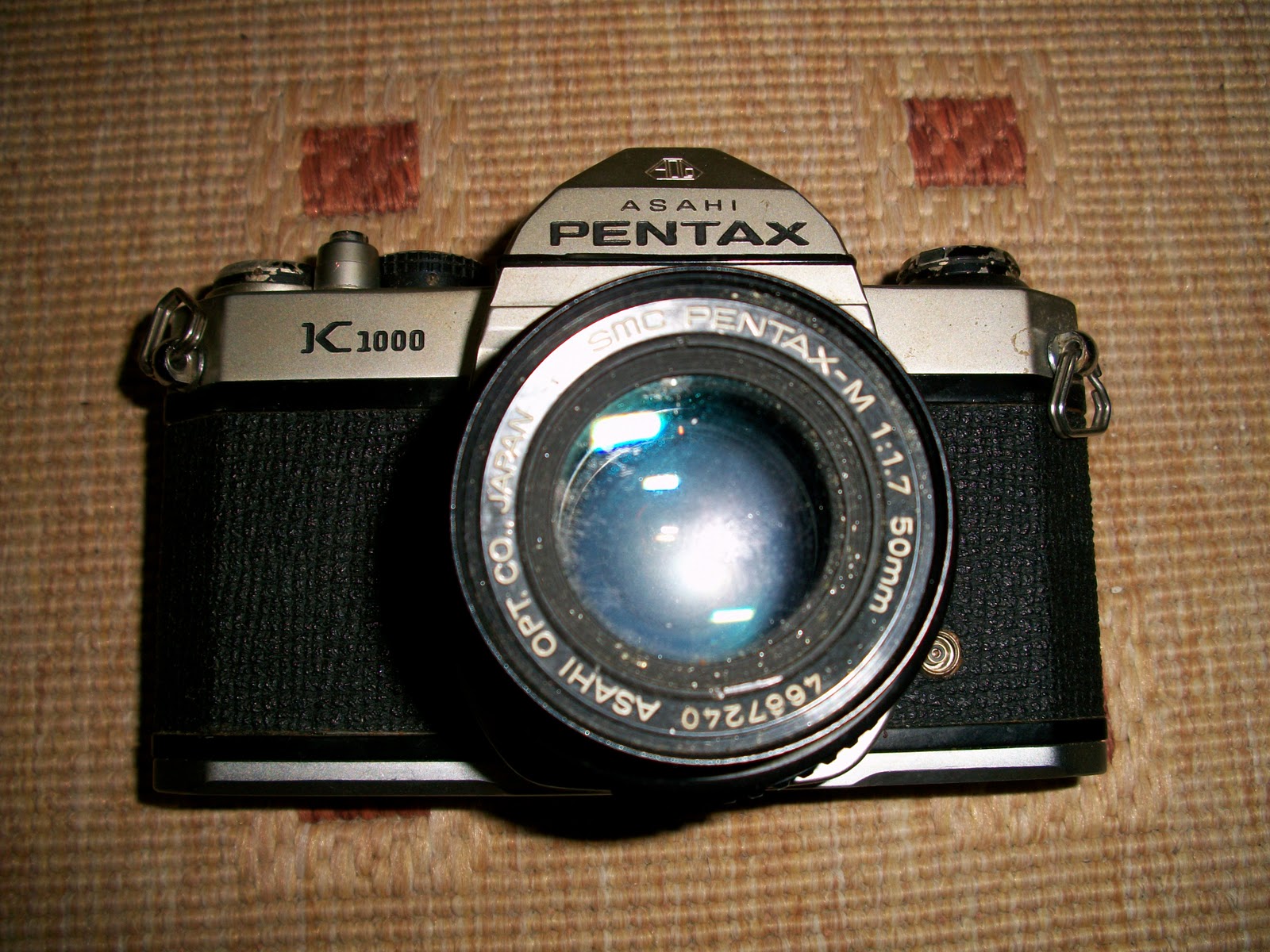
Asahi PENTAX K1000 vintage camera
Selling this camera for parts or collection only. Never tested and do not know whether working or not.
Price:RM120
History of K1000 Pentax Asahi
The Pentax K1000 (originally marked the Asahi Pentax K1000) is an interchangeable lens, 35 mm film, single-lens reflex (SLR) camera. It was manufactured by Asahi Optical Co., Ltd. (renamed PENTAX Corporation in 2002; acquired by Hoya Corporation in 2008) from 1976 to 1997, originally in Japan. It uses a horizontal travel, rubberized silk cloth focal plane shutter with a speed range of 1/1000 second to 1 second, along with Bulb and a flash X-sync of 1/60 second. It is 91.4 milimetres tall, 143 mm wide, and 48 mm deep, and weighs 620 grams. It was finished in black leather with chrome trim only. (Unlike most SLRs of its generation, there was no all black version.) However, the early production Pentax K1000 SE (see below) bodies had brown leather with chrome trim.
The introductory US list price for the K1000 body with SMC Pentax 55 mm f/2 lens was $299.50. In 1983, a K1000 with SMC Pentax-M 50 mm f/2 lens listed for $220; in 1988, the body only was $210, but $290 with SMC Pentax-A 50 mm f/2; in 1993, the body only was $263. The body plateaued at $315 in 1994 and remained there until discontinued. Note that SLRs usually sold for 30 to 40 percent below list price.
The K1000 is the simplest member of Asahi Optical's Pentax K-series SLRs, whose other members are the Pentax K2, KM, and KX, all introduced in 1975, and the K2 DMD (1976). All have the same basic body design, but with differing feature levels, internal electronics, and external controls and cosmetics.
The K1000's extraordinary longevity makes it a historically significant camera, despite its very ordinary design. The K1000 inexpensive simplicity was a great virtue and earned it an unrivaled popularity as a basic but sturdy workhorse, particularly suited to educating inexperienced photographers. The Pentax K1000 eventually sold over three million units.
Solingen Straight Razor Blade - New Old Stock
11th July 2011 Sold to Mr Ade from Temerloh, Pahang, Malaysia
This is a vintage unused Solingen Razor.NOS and Old, but in good condition, it should clean up and sharpen well should you wish to use it...
Written on the razor "F.Herder's" real german hollow ground. Friedr. herder abr. sohne solingen germany.
Price:RM180
Knives of Solingen, Germany
The city of Solingen was founded in 1374. It has long been an active center for the production of high quality cutlery.
Although they may have changed hands many times several of the knife producers that exist in Solingen today have been around for more than one hundred years.
Hermann and Robert Boeker, for example, began production of sabers in 1829 in nearby Remscheid. By 1830 his firm was producing up to 2000 swords per week and employed more than 100 smiths, grinders and laborers.
Later Hermann Boeker would emigrate to the US and founded H. Boeker & Co. in New York. Robert brought the Boeker company to Canada and Mexico in 1865.
In 1869 Heinrich Boeker moved the short distance to Solingen, Germany which was fast becoming a hot bed for industrial tool production. He founded Heinr. Boeker and Co. which produced shaving blades, scissors and pocket knives. As the overseas demand for pocket knives grew, Heinr. Boeker and Co. began to produce more pocket knives and fewer scissors and razors.
As early as the turn of the century the majority of Boeker knives have been exported to the US and distributed by H. Boker & Co. in New York.
J.A Henckels is another company known for their excellence in manufacturing high quality knives and cutlery. They share a similar long term history in the city of Solingen.
In 1731, Johann Peter Henckels, a knife maker based in Solingen, registered the first version of the twin figure symbol we all associate with Henckels knives. In the 260 years since then the symbol has gone through some design changes.
It is now one of the oldest trademarks in existance. Here is a brief outline of the history of the companies pivitol events provided by the Zwilling J.A. Henckels Co.
"1731: Peter Henckels registers the TWIN trademark with Solingens Cutler’s Guild.
1818: Johann Abraham Henckels opens the Company’s first branch office in Berlin.
1851: The Company exhibits its products at the World exhibition in London where it achieves international recognition and is awarded a medal.
1883: A sales office is set up in New York, followed a few years later by Cologne, Vienna, Hamburg, Dresden, Munich and Paris.
1893: World Exhibition in Chicago. The only medal awarded goes to ZWILLING J.A. HENCKELS.
1905: Recognition of another kind: The African explorer Leo Frobenius christens a range of mountains in the then Congo "Zwilling" and another one "Henckels-Berge".
1915: Four first prizes at the World Exhibition in San Francisco.
1938: The company opens a new chapter with the launch of its multi-purpose scissors, setting new standards in design and quality.
1939: Invention of FRIODUR® - a special ice-hardened no-stain steel. This process is patented by J.A. HENCKELS and subsequently all products using this special method are hallmarked accordingly.
1971: A new concept gives fresh stimulus to the market - J.A. HENCKELS knife sets ensure that the right knife is available for every purpose.
1976: International launch of the **** FOUR STAR knife range, meeting the highest quality standards, developed in collaboration with a number of well known German professional chefs.
1981: The Company celebrates its 250th anniversary.
1992: ZWILLING J.A. HENCKELS introduces an entirely new process for the production of cutlery - Sintermetal Component Technology (SCT), developed after many years of research.
1995: Market launch of TWINSTAR, a series of knives setting entirely new standards in cutting performance and featuring Magna Dur® - special-coated blades which remain permanently sharp without re-sharpening.
In addition to its headquarters in Solingen ZWILLING J.A. HENCKELS today has wholly-owned subsidiaries in seven major industrial countries, including the USA and Japan. Products by ZWILLING J.A. HENCKELS are sold in over 100 countries worldwide."
Linder knives have been made in Germany for more than 100 years. They have been making knives since 1870. Solingen City Archives show that Carl Wilhelm Linder started his workshop in a little hamlet named Bech, now part of Solingen, Germany.
His youngest son, Carl, was born in 1869 and carried on his father's tradition of fine knife making. In 1903 Carl Linder moved to a larger location, as they had outgrown their tiny workshop.
In 1918 Linder began to export their knives. In 1937, after Carl Linder's death, the company was sold to Paul Rosenkaimer, a knife maker who had been part of Solingen history for a very long time. He chose to call the company "Carl Liner Nachf."
In German, the word Nachfolger means "successor," and the company is still officially known as Carl Linder Nachf.
In March of 1985 Paul Rosenkaimer died and his son Siegfried Rosenkaimer became the proprietor. If you e-mail or call Linder you can still get a friendly response from Siegfried Rosenkaimer or his son Stephan.
Puma knives are a long time favorite of knife users and collectors from around the world.
Puma-Werk was founded in 1769 in Solingen, Germany. At that time Puma used natural hydraulic water power to drive the large circular wet stones which craftsmen used to shape their knives, razors and tools.
A turning point for Puma was the use of the steam engine which greatly improved production. The first steam engine was invented in 1698 but did not reach wide industrial use until the late 1700s/early 1800s.
After the second World War Oswald Frankeberg joined Puma. He was an experienced hunter and initiated a new policy which would set Puma to producing knives for hunting, fishing and outdoor activities. Puma would no longer make household cutlery. Puma consulted hunting experts world wide to develop knives that would be functional, practical tools for outdoor use.
Two of Puma's most prominant knives are the Universal Jagdtaschenmesser and the famous Great White Hunter developed in 1956.
There are several other knife producers operating from Solingen today including Kissing Cranes, Richartz, Hen and Rooster, Bulldog Brand, German Eye, Hubertus, Herbertz and others. There are also many German knife comapnies that have come and gone.
World Knives goal is to offer a wide selection of the finest and most unique cutlery from around the world in one place. The knives of Germany are an important group for us to represent as they have been such a pivitol part of the development of the modern knife.
Subscribe to:
Posts (Atom)